Designing AI features people trust
Our playbook for grounding, transparency, and human review in production AI.
Shipping an AI feature is easy. Shipping one people actually rely on is not. After building agents for healthcare, sales, and events, we've converged on a short playbook.
1. Ground everything
A feature that answers from the model's memory will eventually make something up. One that answers from your data, with a link back to the source, won't. Retrieval isn't a nice-to-have, it's the difference between a toy and a tool.
2. Show your work
Users trust what they can inspect. Every AI output should carry its evidence one tap away: the record it came from, its confidence, its reasoning. Transparency turns "magic" into "I can check this."
3. Design the human moment
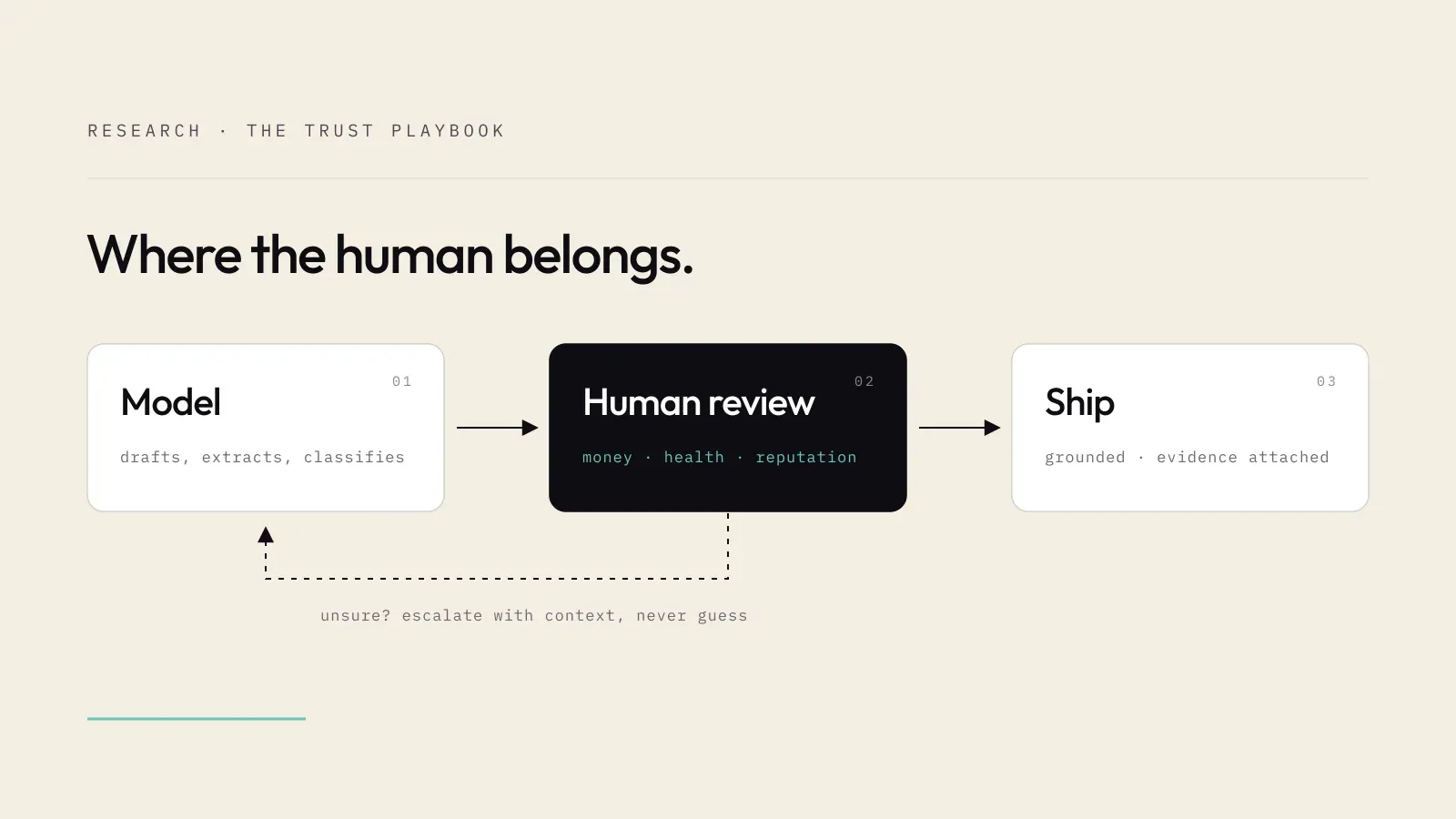
The question isn't "human or AI?" It's where the human belongs. We map every flow for the moments that touch money, health, or reputation, and put a person there, with the context already assembled so the review takes seconds, not minutes.
4. Fail loudly, not silently
- Say "I'm not sure" instead of guessing.
- Escalate with context, not a dead end.
- Make the safe path the easy path.
The best AI feature feels less like magic and more like a very fast, very careful colleague.
That's the bar we build to, and the conversation we're always happy to have.